Ultimate Safety Footwear 2025 Guide (Part 1 – The Real Cost of Ignoring PPE Standards)

- P: Puncture-re
Welcome to Part 1 of our Ultimate Guide to Safety Footwear, your complete resource for understanding, choosing, and maintaining protective footwear for long-term safety and performance.
- What Qualifies as Safety Footwear?
- Are Gumboots Considered Safety Footwear?
- Why Safety Footwear Is Crucial?
- Understanding Safety Standards
- Types and Features of Safety Footwear
- Choosing the Right Footwear for Specific Jobs
- Fit and Comfort – Why It Matters.
- Maintenance and Replacement
- Buying Tips for Employers
- Checklist Before Buying
- Why Sustainability Matters
- Frequently Asked Questions
In Part 2, we will explore how to choose, maintain, and manage footwear for long-term performance. Let’s dive int
Why Choosing the Right Safety Footwear Matters
Choosing the right safety footwear can make the difference between a normal workday and a life-changing injury.Every day, workers are exposed to hazards like falling objects, slippery surfaces, sharp debris, and extreme weather conditions. Yet, many companies and employees underestimate the role of proper footwear in workplace safety.
According to theNational Safety Council, over 53,000 foot injuries occur annually in the U.S. alone. Just one serious foot injury can cost more than R100 000 in medical treatment, downtime, and compensation.
This guide will help you understand what qualifies as safety footwear, how to choose the right type for your work environment, and why making the right choice saves lives and money. Whether you are an employer buying PPE for your team or an employee purchasing your own pair, this information will help you make an informed decision.
WHAT IS SAFETY FOOTWEAR AND WHAT IS NOT?
What Qualifies as Safety Footwear?
Before spending money on work boots or shoes, it’s essential to understand what truly qualifies as safety footwear. While many shoes may appear tough or durable, looks alone don’t guarantee protection from real workplace hazards. Safety footwear is engineered, tested, and certified to meet specific safety standards and that makes all the difference.
What Is Safety Footwear?
Safety footwear is any work shoe or boot that has been:
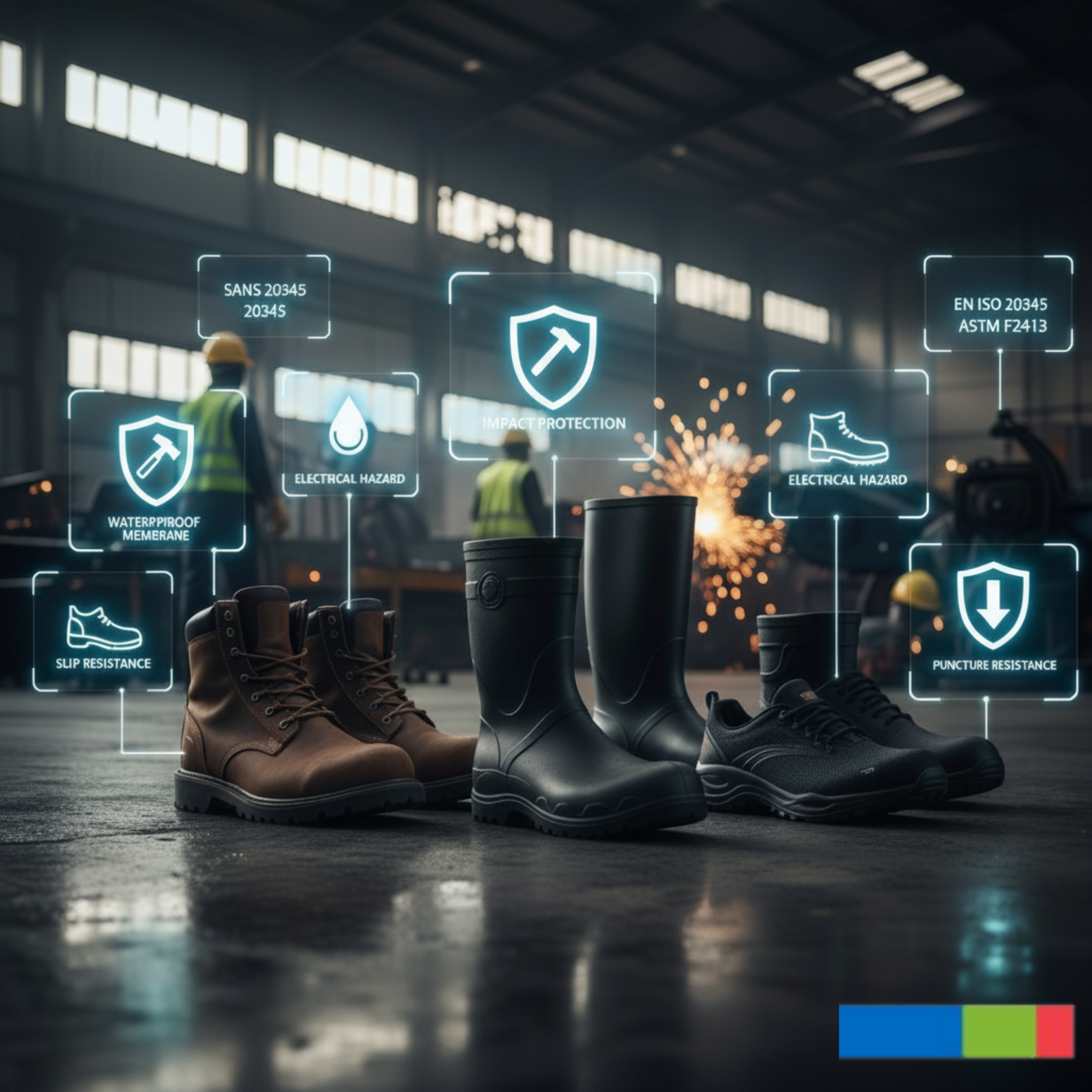
- Independently tested and certified to meet official safety standards (such asSANS/SABS,EN ISO 20345,ASTM F2413,NRCS, orCE).
- Designed to reduce or eliminate risks from common workplace hazards like:
- Falling or rolling objects
- Sharp or piercing materials
- Slippery floors
- Electrical hazards
- Heat or cold exposure
- Chemical spills
Key Features to Look For
When shopping for safety footwear, evaluate both certification and protective features. Here’s what to check:
✅ Look for a certification label/tag inside the shoe or boot. This is usually stitched into the tongue or lining and includes the safety standard (e.g., SANS 20345, EN ISO 20345:2011, ASTM F2413-18).
✅ Match the features to your job requirements. Not all safety footwear needs every feature. Depending on your work environment, one or two key protections may be enough.Common Safety Footwear Features
Feature What It Does Required For… Steel/Composite Toe Cap Protects toes from impact or compression Construction, warehousing, logistics Puncture-Resistant Midsole Prevents sharp objects from penetrating the sole Manufacturing, waste, construction Slip-Resistant Sole Reduces the chance of slips and falls on wet/oily floors Kitchens, hospitals, outdoor work Electrical Hazard Protection Insulates against shocks from live circuits Electricians, engineers Heat/Cold Resistance Protects feet from burns or frostbite Foundries, cold storage Waterproofing/Chemical Resistance Shields feet from liquids and harmful substances Agriculture, chemical processing Note: Even if footwear only has one or two of these features (e.g., a steel toe or slip-resistant sole), it may still be certified as safety footwear if it meets a recognized safety standard.
What Is Not Considered Safety Footwear?
Just because footwear is tough-looking or rugged doesn’t mean it’s safe for industrial use. If it doesn’t meet official standards or lacks specific safety features, it cannot be considered proper PPE.
🚫 Examples of Non-Safety Footwear:
- Stylish boots with no certification or labelling
- Hiking boots without protective toe caps or slip resistance
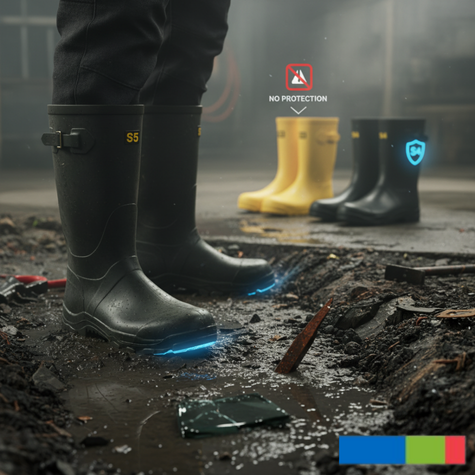
- Gumboots sold only as waterproof but not S4 or S5 rated
- Sneakers, even “heavy-duty” ones, unless certified
Example:
A warehouse worker wears sneakers because they are “comfortable.” A heavy box falls on their foot, causing fractures. Certified safety shoes with toe protection would have prevented this injury.
ARE GUMBOOTS CONSIDERED SAFETY FOOTWEAR?
Not all gumboots are designed for workplace safety. While they may look similar, key differences exist between regular gumboots and safety-rated gumboots that affect protection in hazardous environments.
Key Differences: Regular vs. Safety Gumboots
Type of Gumboot Description Safety Features Best Suited For Regular Gumboots Designed mainly for waterproofing and light use. Typically made of PVC or rubber. No internal safety certifications. 🚫 No toe protection
🚫 No puncture resistance
🚫 No slip-resistant outsoleGardening, rainwear, casual use, household cleaning S4 Safety Gumboots Meet EN ISO 20345/SANS standards. Feature a protective toe cap (steel or composite) but no puncture-resistant midsole. ✅ Toe protection
✅ Antistatic properties
✅ Energy-absorbing heel
✅ WaterproofFood processing, hygiene zones, light factory work S5 Safety Gumboots Highest protection gumboots with both a toe cap and puncture-resistant midsole. Also feature slip resistance and antistatic soles. ✅ Toe protection
✅ Puncture resistance
✅ Slip-resistant sole
✅ WaterproofAgriculture, sanitation, sewage, chemical handling, mining Specialty Safety Gumboots May have additional features such as chemical resistance, thermal insulation, or electrical hazard protection. ✅ Custom features based on task (e.g., acid resistance, heat insulation) Oil & gas, chemical industry, cold storage, labs Real-Life Example:
A sanitation worker at a wastewater treatment plant wears S5-rated gumboots. These provide:- Steel toe protection from dropped tools and heavy lids
- Puncture resistance from sharp debris on the ground
- Waterproofing to prevent contamination from wet surfaces
- Slip resistance to avoid falls on wet and oily floors
Had they worn regular gumboots, they would be vulnerable to injury and contamination.
What to Look for When Buying Gumboots
- ✅ A visible certification label (S4, S5, EN ISO 20345, SANS 20345, CE mark, etc.)
- ✅ The specific features you need based on your work risks
- ✅ A durable build (reinforced toe area, grippy sole, strong seams)
- ✅ Compatibility with your work environment (e.g., chemical resistance for labs)
Tips:
- Don’t rely on looks alone – insist on certification.
- Match features to workplace hazards – not all environments require S5.
- Choose comfort and safety – a poorly fitted boot can still cause long-term injury.
WHY SAFETY FOOTWEAR IS CRUCIAL
Your feet are constantly exposed to risks at work. Injuries can leave you unable to walk or work for weeks or months.
Hazards safety footwear protects against:
- Falling objects: Tools, bricks, or materials can crush toes
- Sharp objects: Nails, glass, or metal debris can puncture soles
- Slippery surfaces: Oil, water, or mud can cause falls
- Chemicals: Harmful liquids can seep through ordinary shoes
- Electrical risks: Live wires can cause electrocution
- Extreme temperatures: Hot tar, freezing ice, or molten materials can burn or damage regular soles
Additional benefits:
- Employers are legally required to provide certified safety footwear
- Comfortable footwear reduces fatigue and improves focus
- Fewer injuries reduce insurance claims and costs
One Job, Different Environments – Why the Same Shoe Doesn’t Work Everywhere
Scenario 1: A company has cleaning teams in two different cities:
- Team A cleans streets in very hot regions where the ground temperature can reach over 40°C.
- Team B cleans streets in rainy, coastal areas where the ground is slippery.
Solution:
- Team A needs boots with heat-resistant soles (HRO) and breathable uppers.
- Team B needs waterproof boots with deep tread soles for traction.
Lesson: Even if teams do the same job, the environment matters. Footwear should match hazards and climate.
Scenario 2: A logistics company buys one type of low-cut S1P shoe for all workers:
- Warehouse workers are fine on dry, smooth floors.
- Truck drivers delivering goods in muddy sites slip and fall due to inadequate soles.
Lesson: Match footwear features to the environment, not just the job title.
UNDERSTANDING SAFETY STANDARDS
When it comes to PPE and safety footwear, certification isn’t just a formality — it’s a legal requirement in South Africa. All safety shoes and boots must comply with SANS/ISO 20345 standards and be certified by the South African Bureau of Standards (SABS).
SABS/SANS Standards and NRCS Regulation
In South Africa, foot protection is regulated by the National Regulator for Compulsory Specifications (NRCS) under the VC specification for safety footwear. This enforces compliance with SANS 20345, the national standard for protective footwear.
Every certified safety shoe must:
- Be tested for 200-joule toe impact resistance (equivalent to a 20 kg object dropped from one metre).
- Demonstrate puncture resistance, slip resistance, and, where required, electrical or heat protection.
- Carry a valid NRCS Letter of Authority (LOA) linked to its VC number, confirming it meets compulsory safety requirements for PPE footwear.
🚫 Important: Safety footwear cannot be imported or sold in South Africa without NRCS approval. Importers must obtain an LOA from the NRCS before bringing products into the country. This process ensures that only compliant, tested footwear enters the market, protecting both workers and employers from liability.
👉 Tip: Always ask your supplier for proof of SABS certification and an NRCS LOA before purchasing safety footwear in bulk or for company use.
EN ISO 20345 (Europe) Classifications
- SB: Basic toe protection only, for low-risk workplaces
- S1: SB plus antistatic sole and energy-absorbing heel
- S1P: S1 plus puncture-resistant midsole
- S2: S1 plus water-repellent upper
- S3: S2 plus waterproof shaft and slip-resistant sole
- S4: Fully waterproof boots, rubber/polymer
- S5: S4 plus puncture-resistant midsole and enhanced slip resistance
Extra codes:
- P: Puncture-re