Elevate Your Workplace: The 2025 Guide to Flawless PPE Compliance in South Africa (Part 2 – How to Get Certified)

Welcome back! This is Part-2 of our guide to PPE compliance and certification in South Africa.
👉 If you haven’t readPart-1 yet, we recommend starting there to get the full context on PPE regulations, compliance standards, and why certification matters.
Recap of Part 1
In Part 1, we covered:
- Why PPE compliance is crucial for workplace safety and legal responsibility.
- The key regulatory bodies: SANAS, SANS, SABS, and NRCS.
- How South African PPE standards align with international standards such as ASTM, ISO, and CE.
- The role of each organization in the PPE certification process:
- SANAS accredits testing laboratories.
- SANS defines technical quality and safety standards.
- SABS tests and certifies PPE.
- NRCS enforces legal approvals and monitors compliance.
- SAHPRA oversees medical PPE such as gloves, masks, and gowns to ensure they are safe and effective before being used in healthcare environments.
What Part 2 Covers?
In this post, we focus on practical steps to get PPE certified and ensure it is legally compliant in South Africa. Specifically, we’ll cover:
- Why the Occupational Health and Safety Act (OHSA) Matters for PPE?
- How Regulatory Bodies (SABS, NRCS, SAHPRA, SANAS, SANS) Ensure PPE Quality?
- Step-by-Step PPE Certification Process in South Africa?
- How to Identify and Verify Certified PPE?
- How to Avoid Buying Fake or Non-Compliant PPE?
- Frequently Asked Questions (FAQs)
By the end of Part 2, you’ll know how to navigate the certification process, verify PPE authenticity, and make safer choices for your workforce, whether you are a manufacturer, importer, or employer.
Why the OHSA Matters for PPE in Your Workplace?
Before any Personal Protective Equipment (PPE) can be sold, distributed, or used in South African workplaces, it has to meet strict legal requirements and safety standards. The Occupational Health and Safety Act (OHSA) 85 of 1993 makes it clear that employers are responsible for providing equipment that truly protects employees from workplace hazards.
But it’s not just about handing out gear, employers need to assess risks, supply the right PPE at no cost, ensure it’s used properly, train staff on its use and care, and keep it clean and safely stored.
On the other side, employees play their part too, they must wear the PPE correctly, follow safety procedures, and take care of the equipment to prevent damage or misuse.
Understanding and following these rules is the first step toward keeping everyone safe and making sure PPE is legally compliant.
How Do Regulatory Bodies Like SABS, NRCS, SAHPRA, and SANAS Ensure PPE Quality?
- SABS (South African Bureau of Standards): SABS tests PPE rigorously against national standards and issues the SABS Approved mark to products that meet the criteria. This ensures that the equipment is safe, reliable, and ready for workplace use.
- NRCS (National Regulator for Compulsory Specifications): NRCS provides legal oversight by enforcing compulsory standards. It issues a Letter of Authority (LOA) for PPE, granting legal approval for sale and distribution within South Africa. This step ensures only compliant products reach the market.
- NRCS checks the PPE that is affected by compulsory specifications to confirm it meets legal safety rules and issues a Letter of Authority (LOA) so the product can be sold in South Africa.
- SANAS (South African National Accreditation System): SANAS accredits the laboratories that test PPE, guaranteeing that testing is accurate, reliable, and internationally recognized. This accreditation ensures that test results can be trusted both locally and abroad.
- SANS (South African National Standards): SANS defines the technical requirements for PPE design, durability, and performance. By setting these standards, SANS ensures that PPE can effectively protect workers against workplace hazards.
- SAHPRA (South African Health Products Regulatory Authority): SAHPRA regulates medical PPE, such as surgical masks, gloves, and gowns used in hospitals and clinics. It checks that these products are safe, effective, and of good quality before they can be sold or used in healthcare.
By understanding how these regulatory requirements translate into actionable steps, manufacturers, importers, and procurement officers can confidently move into the certification process. This ensures that every helmet, glove, boot, or mask is not only legally compliant but also reliable and safe for employees in high-risk industries.
How does the PPE certification process work in South Africa?

As mentioned in Part 1 of this series, only PPE that is affected by compulsory specifications needs to be tested, verified, and legally approved via the NRCS processes. Secondly, only PPE that falls within the mandate of SAHPRA needs to be tested, verified, and legally approved via the SAHPRA processes. However, it is best practice that employers ensure their PPE complies with relevant SANS standards to give confidence to workers using them that their PPE is safe to use and has been produced and tested in line with stringent quality standards.
Therefore, the first step in this process is to understand the applicable PPE regulations in South Africa.
Once regulations are understood, the next critical step is certifying PPE to ensure it meets South African and international safety standards.
This certification process ensures that every protective product, whether locally manufactured or imported, is tested, verified, and legally approved for workplace use.
This process is essential for:
- Manufacturers: Producing PPE aligned with SANS and international standards
- Importers: Legally bringing PPE into South Africa while ensuring compliance
- Procurement managers and safety officers: Purchasing equipment that protects workers and reduces liability
Certification involves multiple steps, including design alignment, laboratory testing, SABS approval, and regulatory verification.
Below, we illustrate the process with two examples: locally manufactured surgical gowns andimported nitrile gloves.
What is the PPE certification process for locally manufactured products?
Local Manufacturing Example – Surgical Gowns
Step 1: Compliance with SANS and NRCS Requirements
Step 1: Compliance with SANS and NRCS Requirements Before initiating design, manufacturers must familiarize themselves with the relevant South African National Standards (SANS) and NRCS requirements. This proactive approach ensures that the product aligns with national safety standards from the outset.
Step 2: Design According to SANS Guidelines Design the surgical gowns in accordance with SANS guidelines, focusing on aspects such as:
- Fabric Type: Selection of materials that offer appropriate protection.
- Fluid Resistance: Ensuring the gown provides adequate resistance to bodily fluids.
- Durability: Designing for longevity and resistance to wear and tear.
- Heat and Flame Resistance: Incorporating features that protect against heat and flames, crucial in emergency and surgical settings.
Step 3: Laboratory Testing Submit samples to SABS or SANAS-accredited laboratories for testing. These tests assess:
- Fluid Penetration Resistance: Evaluating the gown’s ability to prevent fluid penetration.
- Fabric Strength and Tear Resistance: Ensuring the material can withstand physical stress.
- Heat/Flame Resistance: Testing the gown’s resistance to heat and flames.
Step 4: SABS Review and Certification Upon successful testing, SABS reviews the results and, if compliant, issues the SABS Approved mark, signifying adherence to national safety standards.
Step 5: SAHPRA Review, Registration, and License
- Surgical gowns are not only PPE but are also classified as medical devices, which makes them fall within the general mandate of SAHPRA.
- Within this mandate, medical devices are classified into Class A (low risk), B (low to medium risk), C (medium to high risk), or D (high risk).
- In terms of the SAHPRA regulations, surgical gowns fall in the Class A category.
- In general, Class A medical devices do not need SAHPRA licensing, except those devices that have a measuring ability or need to be sterile.
- Therefore, non-sterile surgical gowns don’t need a SAHPRA license.
- On the other hand, sterile surgical gowns do need a SAHPRA license.
- This means if an entity wants to manufacture and/or distribute and/or sell sterile surgical gowns in South Africa, they must submit technical documents, lab reports, and SABS certificates to SAHPRA for review, registration, and a license.
- Once approved, the sterile surgical gowns can be legally sold and used in healthcare settings in South Africa.
Step 6: NRCS Involvement in the Regulation of Surgical Gowns
- There are no compulsory specifications that regulate surgical gowns (sterile or non-sterile) in terms of the NRCS mandate.
- Therefore, the NRCS plays no role in the manufacture, distribution, or sale of surgical gowns in South Africa.
- This means the only party that gets involved in this process is SAHPRA.
How is imported PPE certified and approved for South African markets?
Importing PPE Products Example – Nitrile Gloves
Step 1: Confirm Compliance with International Standards Ensure that the imported PPE complies with international standards such as:
- CE Marking: A certification symbol found on products sold in Europe; it indicates conformity with health, safety, and environmental protection standards within the European Economic Area.
- ASTM Standards: These are international rules and guidelines created by the American Society for Testing and Materials (ASTM International); they provide specifications for materials, products, systems, and services.
- ISO Standards: International standards ensuring quality, safety, and efficiency. They help companies follow the same safety and quality practices worldwide, so PPE and other products meet global safety expectations.
Step 2: Collect Documentation Obtain all relevant compliance certificates and accredited laboratory test reports from the foreign manufacturer. These documents demonstrate that the PPE meets safety and quality standards.
Step 3: SAHPRA Review, Registration, and License
- Nitrile gloves are not only PPE but are also classified as medical devices, which makes them fall within the general mandate of SAHPRA.
- In terms of the SAHPRA regulations, nitrile gloves fall in the Class A category.
- As mentioned before, in general, Class A medical devices do not need SAHPRA licensing, except those devices that have a measuring ability or need to be sterile.
- Therefore, non-sterile nitrile gloves don’t need a SAHPRA license.
- However, sterile nitrile gloves do need a SAHPRA license.
- This means if an entity wants to manufacture and/or distribute and/or sell sterile nitrile gloves in South Africa, they must submit technical documents, lab reports, and SABS certificates to SAHPRA for review, registration, and a license.
- Once approved, the sterile nitrile gloves can be legally sold and used in healthcare settings in South Africa.
Step 4: NRCS Involvement in the Regulation of Nitrile Gloves
- There are no compulsory specifications that regulate nitrile gloves (sterile or non-sterile) in terms of the NRCS mandate.
- Therefore, the NRCS plays no role in the manufacture, distribution, or sale of nitrile gloves in South Africa.
- This means the only party that gets involved in this process is SAHPRA.
How can you identify and verify certified PPE?
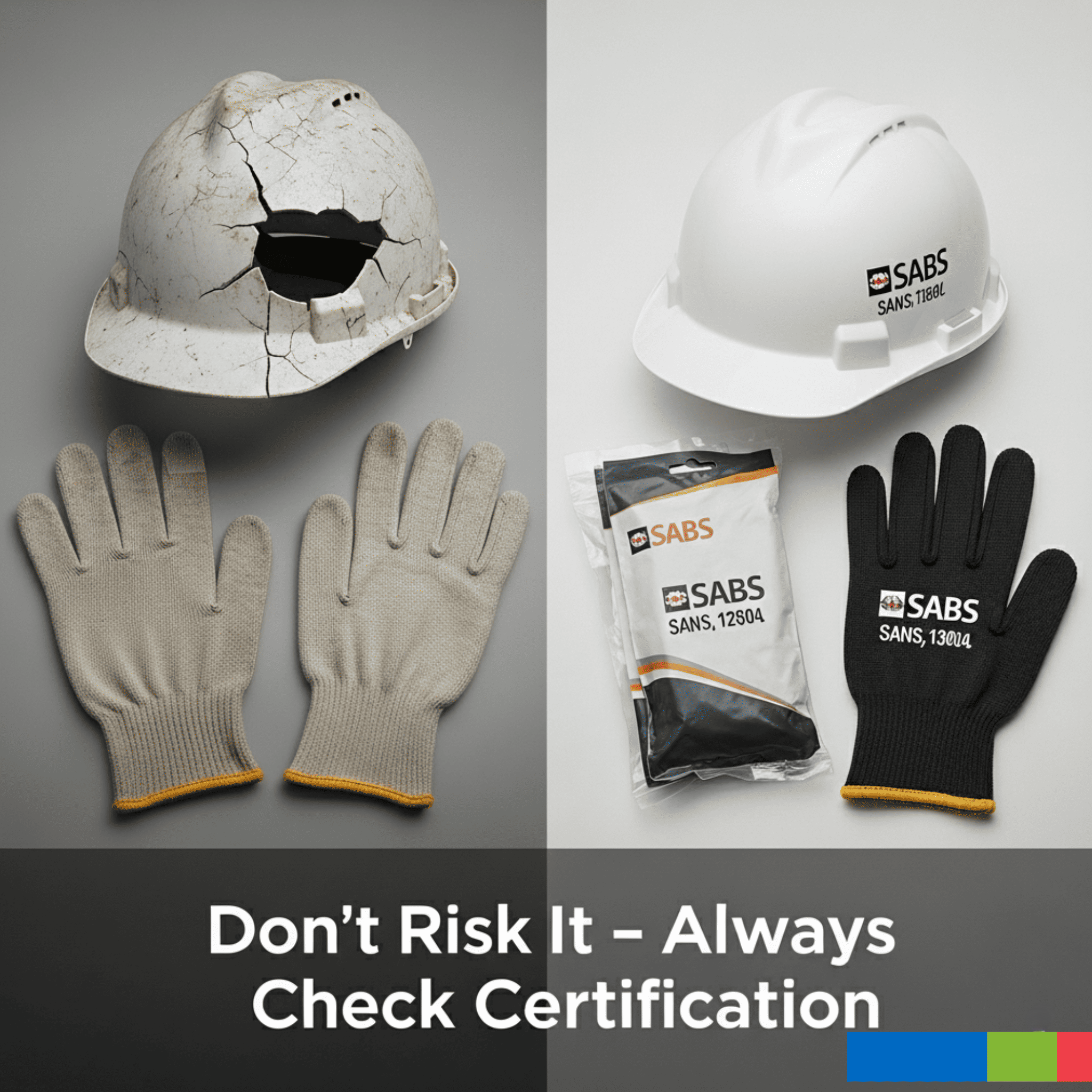
When buying PPE, it’s not enough for it to look tough or durable; it needs to meet real safety standards. Approved PPE has gone through strict testing, often by labs accredited by bodies like SABS, NRCS, SAHPRA, CE, or ASTM, and those approvals are usually printed directly on the product or packaging.
So, how do you check? Let’s go through some common PPE items and show you exactly where to look and what the codes mean.
1. Safety Boots
- Where to Look: Check the tongue, inside label, or engraved on the sole.
- What You Should See:
- SABS Approved or NRCS LOA number (for South Africa).
- EN ISO 20345 (European Standard).
- Example: “EN ISO 20345:2011 S3 SRC” indicates compliance with toe cap strength tests, anti-slip properties, and suitability for industrial use.
SABS-Approved Safety Boots – protective, slip-resistant work boots designed to meet stringent safety standards like SABS and EN ISO 20345.
2. Nitrile Gloves
- Where to Look: Inspect the packaging box or the cuff of each glove.
- What You Should See:
- ASTM D6319 (American standard for medical-grade nitrile gloves).
- EN 374 (European chemical resistance standard).
- Example: “EN 374-1:2016/Type B” signifies protection against specific chemicals and meets lab-tested resistance levels.